 tiebackPre-seed · 2026
Physical items.Digital trust.
Every product sold in the EU will soon need a Digital Product Passport. 1,200 enterprise brands are first up — apparel by 2027, then electronics, furniture, beauty and batteries.
Tieback is the operating system that makes that workable — and turns a regulatory cost into a brand channel.

Compliance is becoming the mostexpensive thing brands don't sell.
ESPR makes a Digital Product Passport mandatory across the EU. Today, brands face this with spreadsheets, agencies and a different process per market. None of it scales.
Apparel first under ESPR. Electronics, furniture, beauty and batteries follow on a published schedule.
No legacy vendor ships this pre-configured. Every brand currently rebuilds compliance per locale.
OECD/EUIPO 2023 — 3.3% of world trade. The same item-level identity solves both problems.
The clock is statutory.The standard is locked. The buyer is ready.
ESPR enters force across the EU
Apparel working plan adopted
DPP scope locked · industry consultation
Apparel DPP enforcement begins
Electronics · furniture · beauty
GS1 Digital Link is the de facto identifier behind ESPR. Competitors built on proprietary IDs and now face a permanent retrofit cost.
Major EU retailers are scoring suppliers on DPP readiness today — ahead of the legal deadline. Brands cannot wait for 2027.
No new hardware to deploy, no app to install. Verification at the speed of a camera tap — finally feasible at brand scale.
The compliance operating systembuilt for the ESPR decade.
Four connected capabilities let any brand issue, govern, prove and activate product passports — without enterprise headcount.
Create signed product passports without a compliance team.
GS1 Digital Link, QR and NFC publishing are bundled into one workflow.

One identity per item.One scan to verify it.
Brands plug their existing systems in once. Tieback issues a unique, tamper-proof identity for every item. Anyone with a smartphone can verify it instantly — no app, no hardware.
One screen for every product,every market, every state.
Brand and compliance teams see DPP readiness, market coverage, and live trust signals in one place — no spreadsheet, no agency, no guesswork.
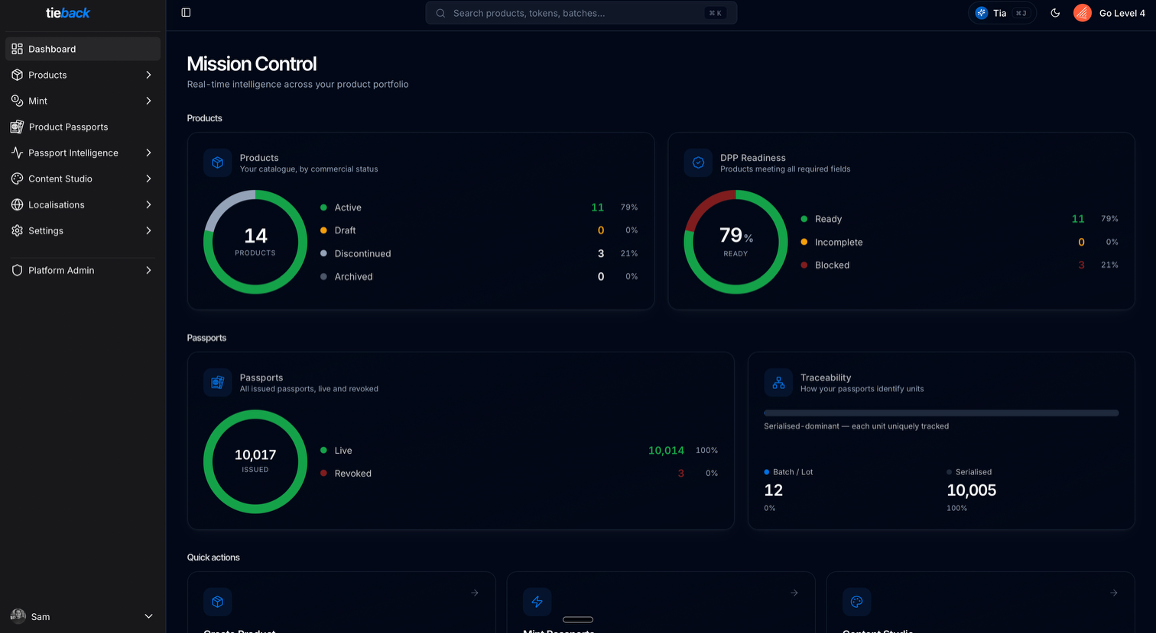
48,505 items live. 100% scan success. Zero compliance incidents.
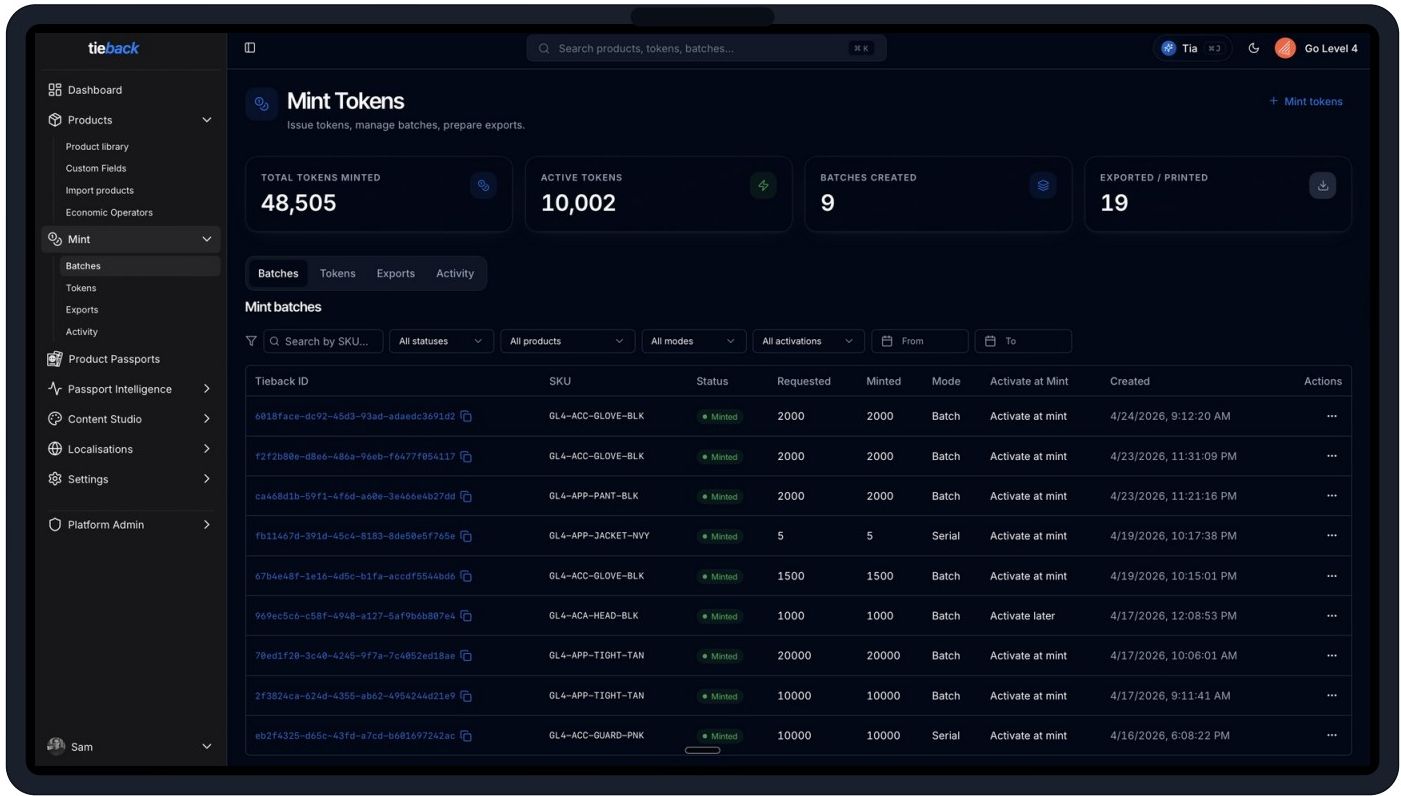
Every item gets its own scannable, tamper-proof identity — using the same standard (GS1) that regulators and retailers have already chosen.
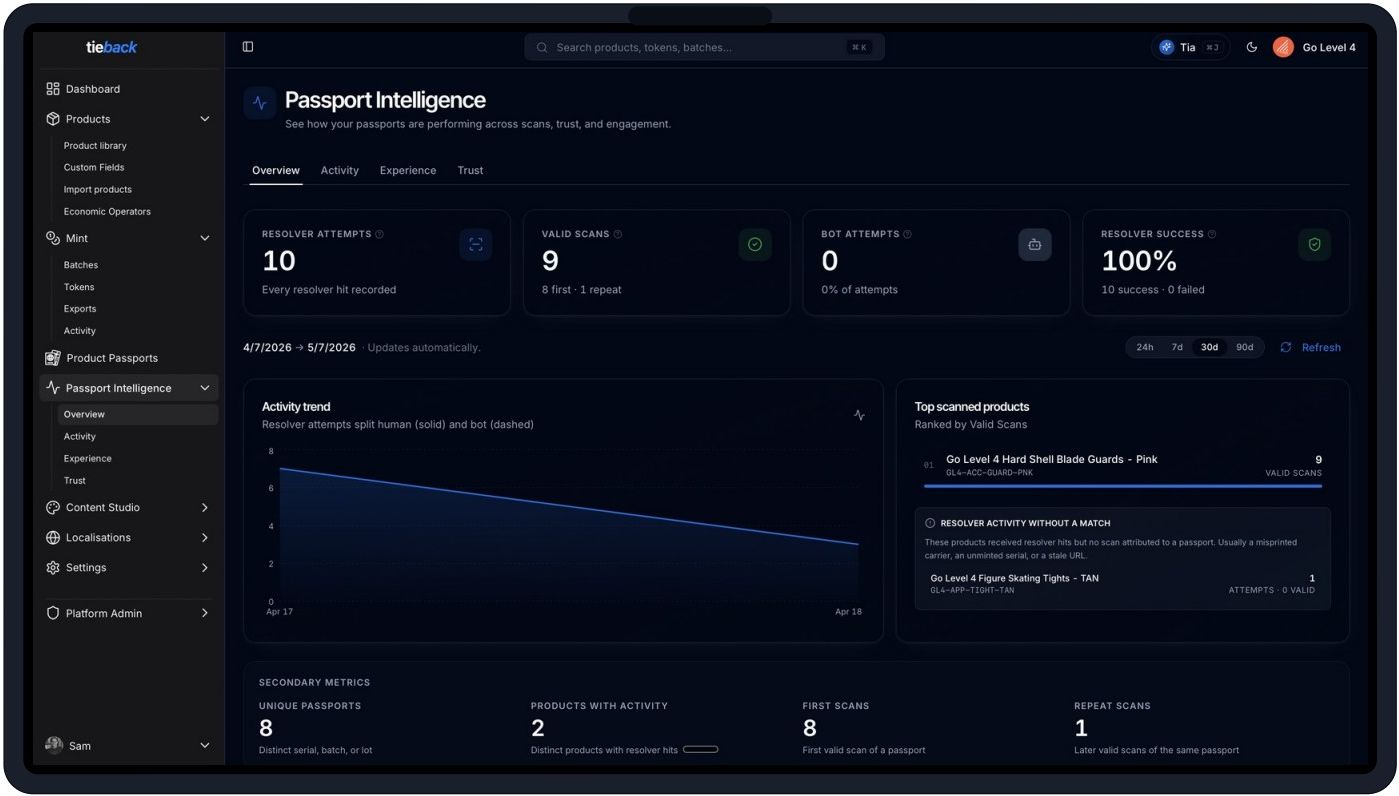
Where, when and how each item is scanned — turned into engagement data for the brand and anomaly alerts for the security team.
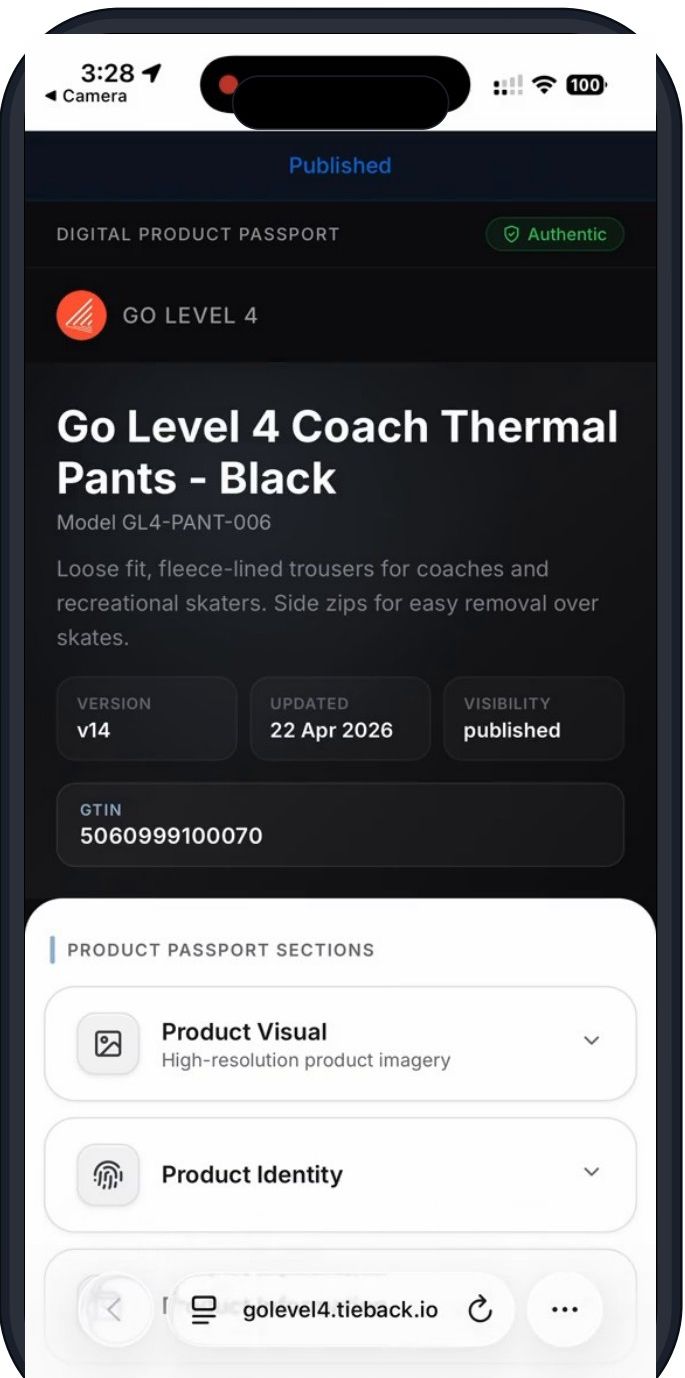
The truth told.The promise kept.
Every passport is a branded experience the customer actually wants to open. Authenticity. Origin. Materials. Care. Resale. The product becomes a direct, owned channel — paid for by compliance.
The brand keeps its promise long after the sale — and gets a live signal every time someone scans.
Compliance today — vs compliance with tieback.
- —A spreadsheet for every market
- —Translations re-done market by market
- —A consultant for every audit
- —A fire-drill for every regulator request
- —The compliance team owns the brand's roadmap
- +One platform, every market
- +Translations governed by the platform
- +Audit dossier in seconds — not weeks
- +Regulators get a timed portal, not a CSV
- +The compliance team disappears into the workflow
Compliance gets us in.The product becomes the channel.
Brands buy us to satisfy a regulator. They keep us because the same item-level identity unlocks the next decade of brand-customer relationships.
ESPR-ready passports, audit dossiers, recall — already in production.
Every consumer scan is a live trust signal. Suspicious patterns flagged in real time.
Authenticated claims, ownership transfers, repair routing — bound to the unit.
Provenance and ownership history make resale frictionless and brand-safe.
Material-aware end-of-life routing — the data ESPR will eventually require.
Loyalty, exclusives, post-sale brand engagement — owned by the brand, not the marketplace.
Apparel is the wedge.The wedge is bigger than it looks.
The first sector pulled into ESPR — the largest, the loudest, and the most exposed to counterfeit.
The brands for whom buying compliance infrastructure is materially cheaper than building it.
When apparel ESPR enforcement bites in Q3 2027, the buying cycle compresses to weeks — not quarters.
One platform. Six regulated waves.Same infrastructure each time.
ESPR doesn't stop at apparel. The same item-level identity, the same regulator workflow, the same multi-market engine — re-deployed across every sector on the published timeline.
What this round buys.Twenty-four months from foundations to platform.
- +Apparel DPP issuance · GS1 Digital Link
- +Mission Control v1 with three design partners
- +Branded passport · 6 EU languages
- +Multi-tenant governance + role-based audit
- +Regulator portal GA — timed dossier delivery
- +NFC + RFID parity alongside QR
- +31-market translation pipeline
- +Electronics + furniture compliance packs
- +Marketplace integrations (Shopify, SAP, Centric)
- +Counterfeit signal API for brand protection
- +Six-wave coverage (apparel · electronics · furniture · beauty · batteries · construction)
- +Certification body partnerships across the EU
- +Consumer trust graph — cross-brand verification
Architectural gaps, not roadmap gaps.
Legacy serialization vendors were built for a pre-ESPR world. In-house builds stall on translation, jurisdiction and mobile verification. We built for the regulation that's actually arriving.
Live SaaS. Real partners.A regulatory deadline doing our selling.
- ✓Live SaaS in productionMulti-tenant platform, used by real brand teams — not a prototype.
- ✓48,505 items issuedReal production traffic, 100% scan success, zero compliance incidents.
- ✓AI compliance co-pilotCuts weeks of manual data work into minutes — every action audit-logged.
- ✓Branded passportsEach brand's passport looks like the brand — not a generic regulator page.
- ✓Smartphone-native verificationAny consumer phone, no app — passport returned in under a second.
- ✓31-market readinessTranslations and disclosures auto-routed per EU jurisdiction, on day one.
CDOs, Brand Directors, VPs Sustainability and Heads of Innovation at EU fashion and luxury brands. The ESPR clock compresses every sales cycle — not us.
Multi-tenant SaaS · enterprise-led ·diagnostic-led top-of-funnel.
CDO, Brand Director, VP Sustainability at EU fashion + luxury.
ESPR Assessment Tool → £4.5k Phase 1 → platform contract.
Zebra ISV, GS1 accreditation, label/print, EU regulator engagement.
One operator. One executive. 40 years inside regulated industries.
The same pattern, observed from both sides of the table.

Wet chemist turned executive. 25 years as CEO, CTO and Managing Director — leading corporates and startups across regulated industries. Executive Board at ERGO, Regional CTO at Generali and AXA across Asia Pacific, 15 years at Cigna scaling digital health to £100M revenue. Active mentor and coach to founders and operators.
"Enterprise transformation is a business-change problem with a technology delivery component. Most programmes are funded as though it's the other way around. Tieback is built to fix that."

Started implementing ERP in process manufacturing. 15 years consulting across regulated industries — pharma, nutraceuticals, chemicals, paints, cosmetics, telco, insurance — on production efficiency, regulatory compliance, traceability, and recall.
"The companies that struggled most weren't the ones with bad technology. They were the ones with fragmented data and compliance held together by spreadsheets. We are building the platform we wished existed."
ERGO · Cigna · Generali · AXA · Munich Re · Bayer · Nestlé · Oxford Saïd · Strathclyde MBA · MIT Applied Agentic AI
£250–750k
SAFE or priced — flexible to lead. 18 months of focused execution. Q4 2027 priced seed target.
Q2 2026 roadmap — wallet, warranty, ownership transfers, dossier export. Resolver and Tia scale. 2 senior eng hires.
Founder-led enterprise motion across EU fashion + luxury. Diagnostic engine + ESPR Assessment Tool top-of-funnel.
GS1 accreditation, SOC 2 Type I, EU regulator engagement, partner ecosystem.
Up to 50% back from HMRCbefore tieback returns a single pound.
Tieback is a UK Ltd company eligible for SEIS and EIS. UK taxpayers materially reduce downside and amplify upside on this round.
- +100% Capital Gains Tax exemption on exit
- +Loss relief offset against income tax
- +50% CGT reinvestment relief on prior gains
- +Inheritance Tax relief after 2 years held
- +100% CGT exemption on EIS share gains
- +CGT deferral on gains rolled into EIS
- +Loss relief at investor's marginal rate
- +Inheritance Tax relief after 2 years held
Trust verified by one scan.
A pricing ladder that grows with the customer.
Brands enter to comply with ESPR. They stay because the same passport becomes their consumer engagement surface. One platform carries them from first SKU to global rollout — no rip-and-replace at any step.
- ·50 product designs
- ·200 passports / year
- ·1 native integration
- ·AI co-pilot (basic)
- ·500 product designs
- ·5,000 passports / year
- ·3 native integrations
- ·1 branded passport URL · 24h SLA
- ·5,000 product designs
- ·100,000 passports / year
- ·10 native integrations
- ·3 branded URLs · priority 4h SLA
- ·SAML SSO · dedicated infrastructure
- ·Unlimited branded passport URLs
- ·Named CSM · 99.95% SLA
- ·White-label option
Software-only economics.£8M Y3 ARR base case · cash-positive cohort by Year 2.
Premium-priced disruption — 10–40× more accessible than legacy enterprise vendors. Mix shifts toward Growth/Enterprise as Wave-1 enforcement (Q3 2027) compresses the cycle.